
Summary:
If your scarring is mixed, with different scar types sitting at different depths, one treatment cannot resolve all of it.
That’s why effective acne scar removal often requires a mapped, sequenced, multi-layer approach, and it starts with an accurate picture of exactly what you are dealing with.
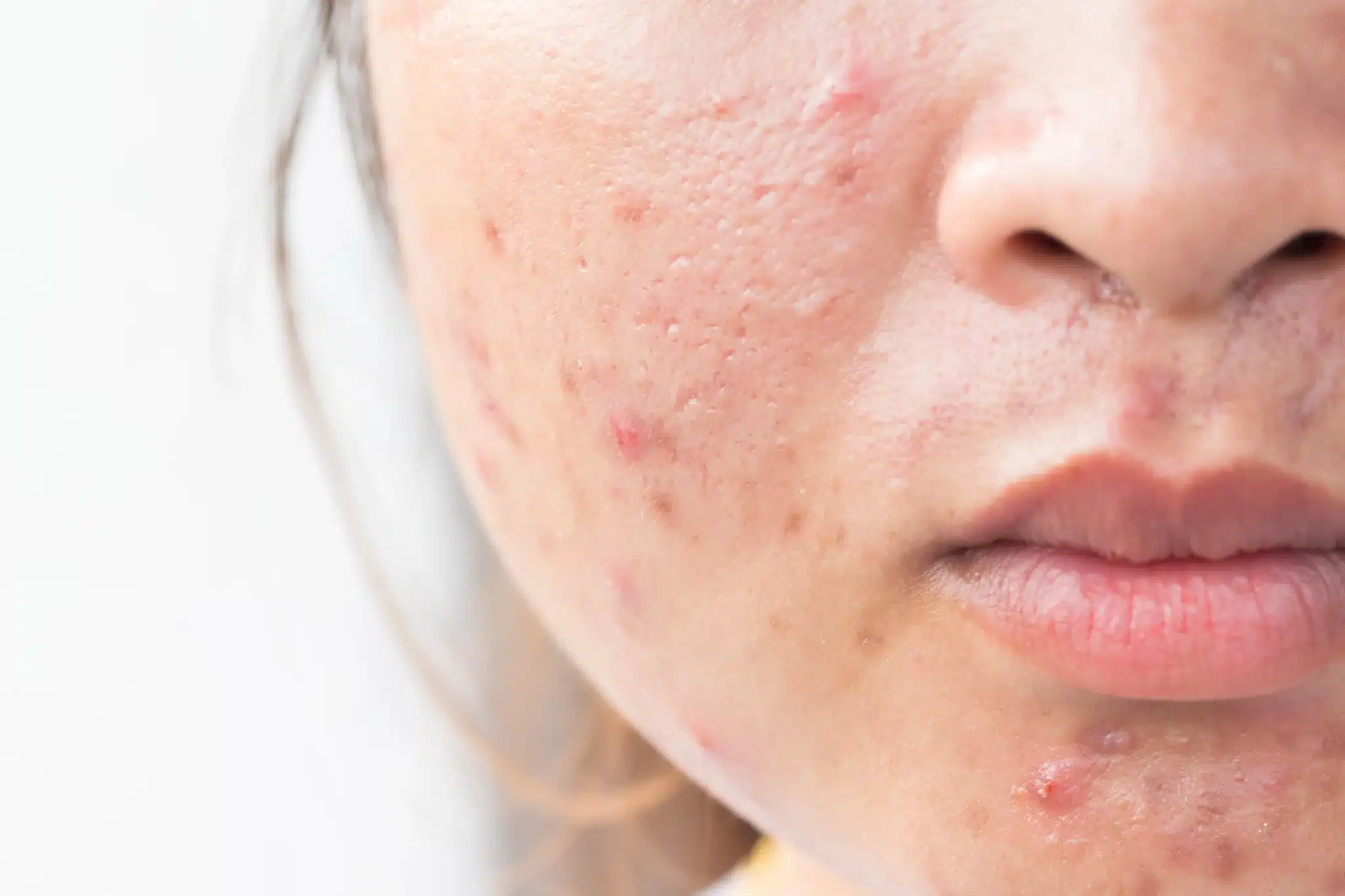
Icepick scars are narrow and deep, extending down through the full thickness of the dermis (the thick middle layer of skin). They form when the follicular wall collapses during a severe inflammatory episode, leaving a channel that can reach the subcutaneous (fatty) tissue below.
Boxcar scars are broader, with well-defined vertical edges and a flat base, representing a localised loss of dermal volume.
Rolling scars produce a wave-like appearance caused by fibrous bands of tissue tethering the underside of the skin to deeper tissue, pulling it downward.
As described in a foundational classification paper in the Journal of the American Academy of Dermatology, unlike icepick and boxcar scars, the primary problem in rolling scars is not tissue loss but mechanical tethering.
Every device used in acne scar treatment operates through a specific mechanism at a specific depth. No single one encompasses all three.
| Treatment | Mechanism | Best suited for | Limitations |
| Fractional CO2 / erbium laser | Ablates surface skin; stimulates dermal collagen remodelling | Surface texture, shallow boxcar scars, post-inflammatory pigmentation | Cannot reach fibrous bands beneath the dermis; limited effect on deep icepick or rolling scars |
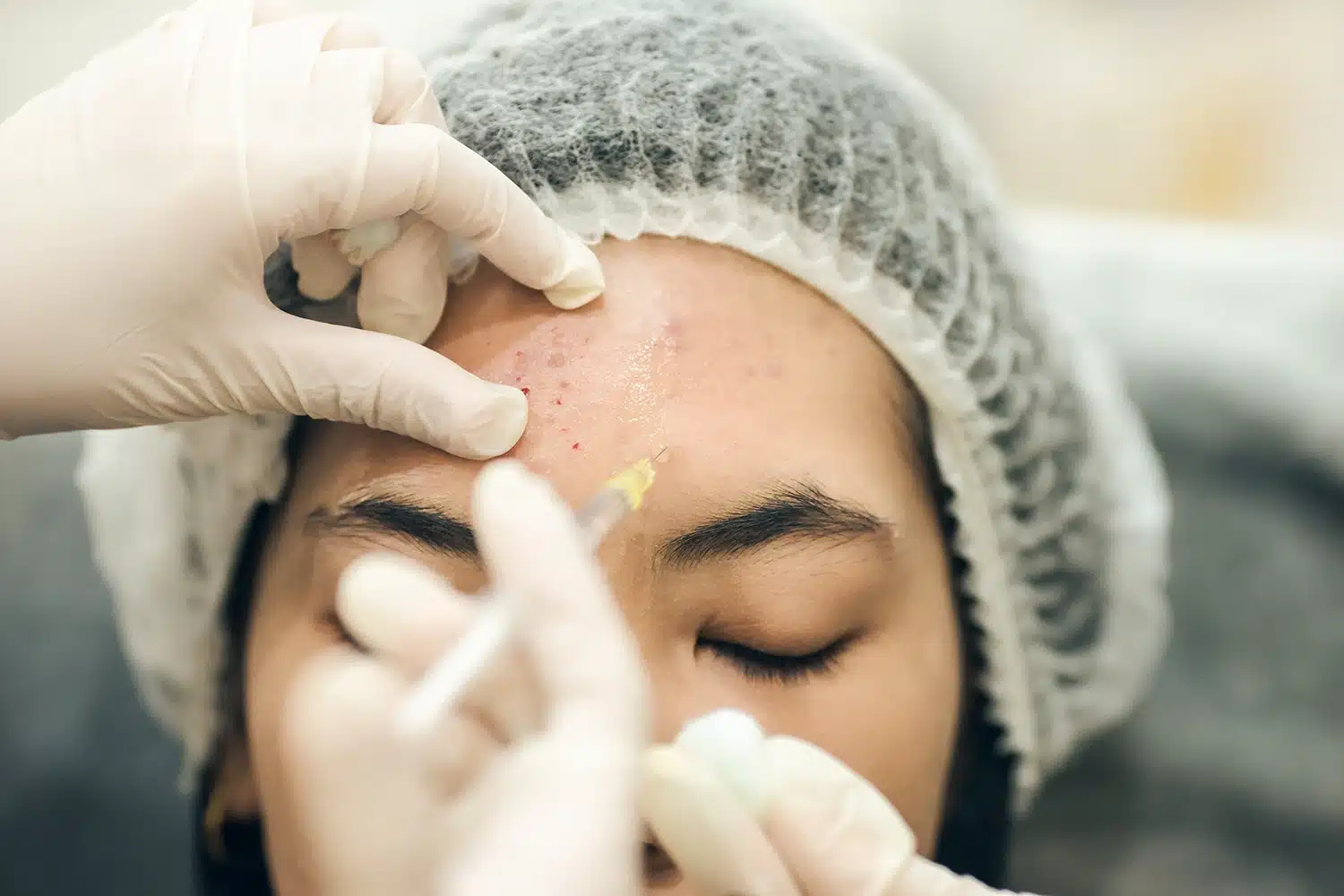
| Fractional microneedle radiofrequency | Delivers thermal energy via insulated needles into the dermis and upper subcutaneous layer | Deeper collagen stimulation; moderate boxcar and rolling scars after release | Does not mechanically sever tethered bands; not the primary tool for pigmentation |
| Subcision | Mechanical severance of fibrous bands beneath the skin | Rolling scars caused by tethering | Does not resurface skin, stimulate broad collagen remodelling, or treat icepick or boxcar scars |
As the Founder and Medical Director of 1Aesthetics, Medical & Surgery in Singapore, I typically recommend fractional microneedle radiofrequency for rolling and boxcar scars as it provides a practical balance between depth of effect and recovery time for most patients. Meanwhile, subcision remains the most direct mechanical solution for the tethering that causes them.
When a single device is applied to a mixed scar field, the scars it was not designed to treat remain unchanged. The net effect is partial improvement that can make the scar field appear more uneven than before, because the treated scars soften while the untreated ones remain unchanged in contrast.
This is a common source of patient frustration: a genuine improvement in one dimension of the problem that still falls short of the overall result.
If your results have been uneven or incomplete, a single-device approach may be the reason. Contact my team at 1Aesthetics to learn more about how mymulti-modal approach works.
If single-device treatment leaves mixed scarring partly unresolved, the answer is not always more of the same treatment. It is a better starting point.
A thorough assessment with me typically covers the following:
After the assessment, I will produce a scar map: a working picture of which scar types are present, where they are concentrated, and how they relate spatially.
This determines which modalities are needed and which can be excluded. The sequencing logic is covered in detail below.
Fractional radiofrequency microneedling and optical lasers work at different depths and through different mechanisms.
Optical lasers work primarily at the epidermal and superficial dermal level, making them the tool of choice for surface texture, pigmentation, and shallow scars.
Fractional microneedle radiofrequency bypasses the epidermis and delivers energy directly into the deeper dermal layers, supporting collagen rebuilding where scars originate. At 1Aesthetics, the depth of delivery is calibrated carefully because if it goes too deep, there is a risk of further atrophy and a sunken appearance.
Mechanical procedures such as subcision, collagen stimulators and TCA CROSS are placed early in the sequence because the wound-healing response they trigger creates a biological environment that is more receptive to the energy-based treatments that follow.
Stacking treatments too closely risks overloading the tissue's repair capacity and increasing the risk of PIH and prolonged erythema (redness).
Collagen stimulation depends on controlled tissue injury. The margin between effective treatment and tissue overload is narrower than many patients realise, and treatment parameters (energy settings, needle depth, pulse duration, and number of passes) must be individualised for each patient and each area of the scar field.
Singapore's population includes a high proportion of patients with Fitzpatrick skin types III to V (medium to darker skin tones that produce more melanin, the pigment responsible for skin colour).
A review of fractional nonablative lasers in darker skin phototypes found that appropriate device selection and conservative treatment settings are crucial for optimising outcomes and minimising adverse events.
Because fractional microneedle radiofrequency is safe and effective in individuals with darker skin phototypes, with dermal remodelling continuing to improve up to six months after treatment, I typically recommend this to patients with higher skin pigmentation.
At 1Aesthetics, sessions are spaced out and energy settings are reviewed and adjusted for each patient's skin type as a standard part of treatment planning.
My approach at 1Aesthetics follows an inside-out sequence, addressing the deeper structural causes before working towards the surface. The logic is similar to building a house from the foundation up: each layer depends on what was corrected before it. Phases are separated by a recovery interval of four to six weeks.
Effective acne scar treatment starts with an accurate picture of what you are dealing with. Without that, the treatment may work on some scars while leaving others unchanged, giving you a partial result that still falls short of what you were hoping for.
At 1Aesthetics, my approach to acne scar treatment in Singapore begins with a thorough scar assessment before any device is discussed.
To arrange an assessment, get in touch with my team. There is no obligation, just a conversation about what your skin needs and what is realistically achievable.
Address:
1Aesthetics, Medical & Surgery
#14-90 The Central Tower 1
8 Eu Tong Sen Street
Singapore 059818
Mon-Fri 10 AM to 730 PM
Sat 10 AM to 6 PM
Phone / WhatsApp:
+65 66125173 / +65 84899962
Email:
[email protected]