
Summary:
The goal of laser mole removal is not to apply as much heat as possible to the mole. It is to apply enough heat, in a short enough window, that the surrounding skin never has time to be damaged.
That distinction is what gives the procedure its best chance of a clean result. On the face, where the skin is thin and every outcome is visible, the margin for error is narrow. The laser parameters, the pulse duration, the energy level have to be calibrated to your specific skin tone and mole characteristics before a single pulse is delivered.
As the Founder and Medical Director of 1Aesthetics, Medical & Surgery in Singapore, that calibration is the basis of how I approach laser mole removal cases in my practice. Here is what that looks like in more depth.
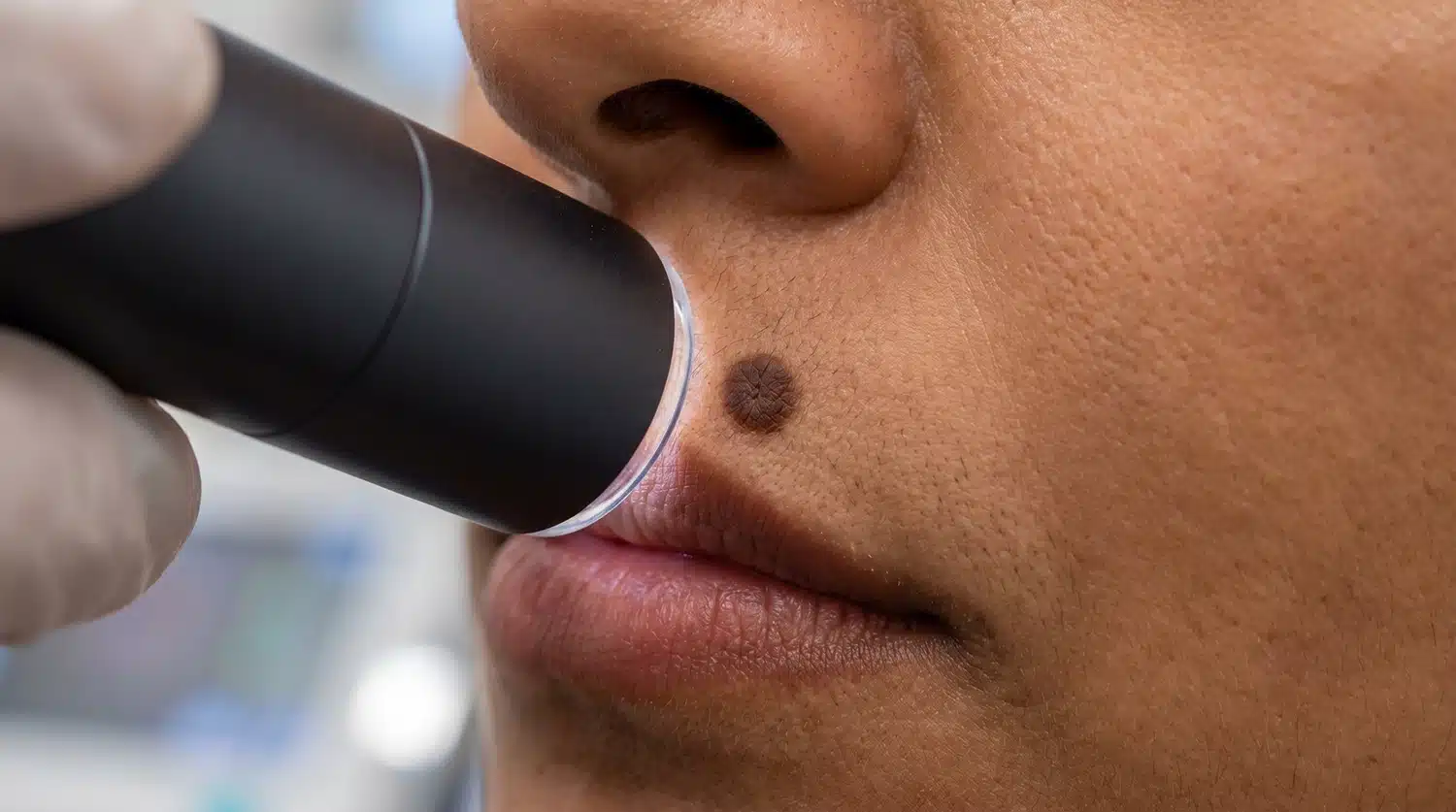
Two factors shape my recommendation when I assess patients for laser mole removal in Singapore: the mole's characteristics and how your skin is likely to respond.
In a suitability assessment, that means I consider the following:
For moles that appear irregular in shape, have uneven pigmentation, or have changed recently, I may recommend a histology assessment.
When a mole is particularly deep or large, staged removal across multiple sessions may be more appropriate than a single laser session.
Not sure whether your mole is suitable for laser removal? Book a consultation at 1Aesthetics for a thorough skin assessment.
Different lasers destroy mole tissue in different ways, and the method depends on whether the mole is raised or flat.
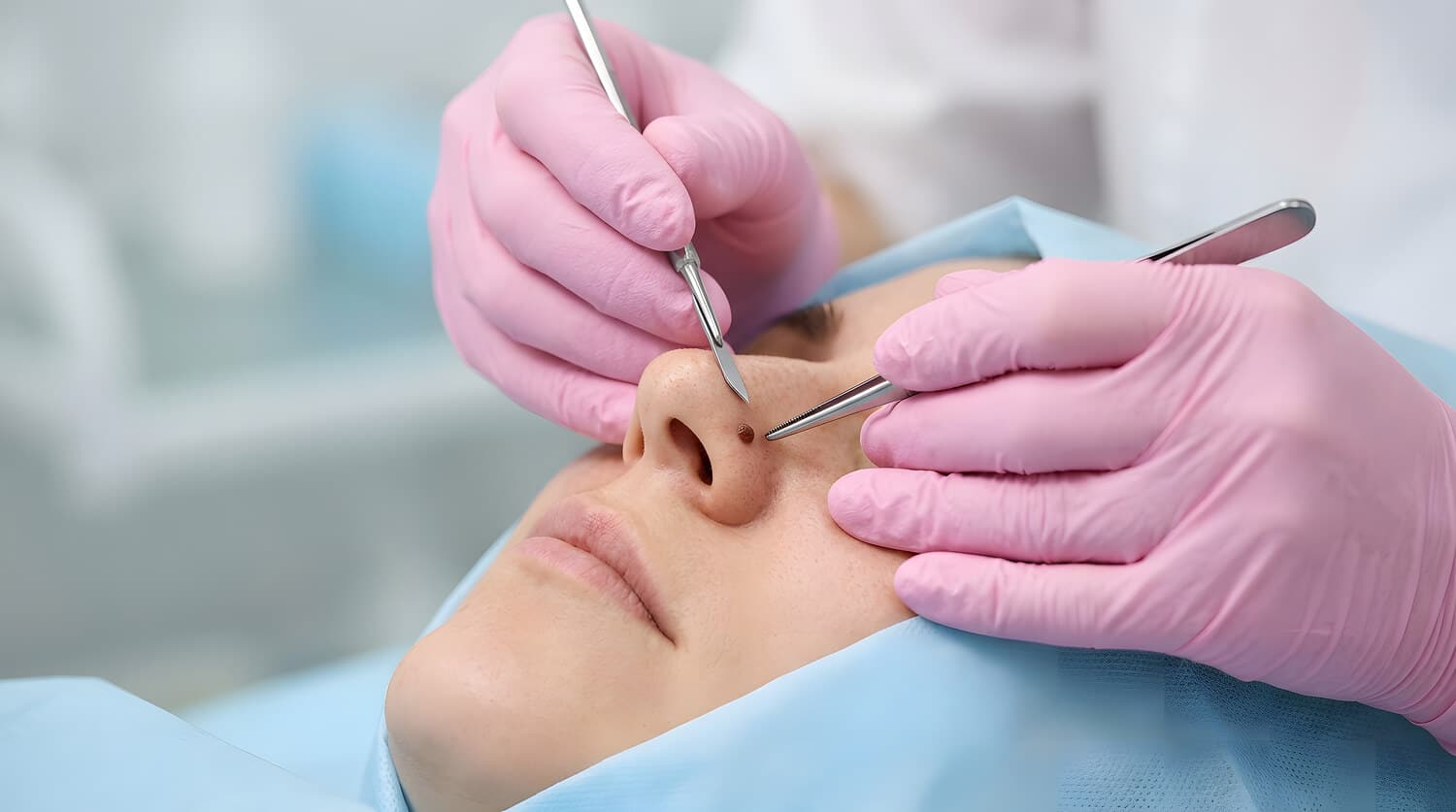
For raised moles, ablative lasers like the CO2 laser heat the targeted cells so quickly that they vaporise almost instantly. Because the heating happens so fast, very little of it spreads into the surrounding skin. This is what allows the laser to remove raised mole tissue layer by layer with minimal collateral damage.
For flat or pigmented moles, pigment lasers such as ruby (694nm) and alexandrite (755nm) work differently. They rely on a principle called selective photothermolysis. The laser is tuned to a specific wavelength that targets melanin, the pigment that gives moles their dark colour. Because the energy is absorbed by that pigment rather than the skin around it, the laser treats the mole itself while mostly leaving the surrounding tissue untouched.
Precision here comes down to timing. Every tissue has a thermal relaxation time, the time it takes to lose half the heat it absorbs. If the laser's pulse is shorter than this window, heat stays contained within the target cells instead of spreading outward. Get the timing right, and the mole is treated with very little effect on the surrounding skin.
This matters most on the face, where structures sit close together and even a small margin of error can cause visible damage. Matching the laser settings to the tissue is essential.
At 1Aesthetics, pigment lasers such as ruby (694nm) and alexandrite (755nm) can be used for flat or pigmented moles, while the CO2 laser targets water in skin cells to vaporise raised mole tissue layer by layer.
|
Laser type |
Target |
Best suited for |
|
Pigment laser (ruby 694nm, alexandrite 755nm) |
Melanin |
Flat or pigmented moles closer to the surface |
|
Ultrapulse CO2 laser |
Water in skin cells |
Raised moles that do not extend deeply |
Which laser is most appropriate depends on the mole's pigmentation and depth, but the physical form of the mole introduces a separate set of clinical decisions that the laser type alone cannot resolve.
Attempting to ablate a large deep mole in a single session requires delivering concentrated energy to a large volume of tissue, increasing both the heat load on the surrounding skin and the depth of the wound. Furthermore, removing a large, deep mole would inevitably leave a large, deep wound, which the skin may struggle to heal fully from.
Instead, I typically taper the borders gradually from the edges inward across multiple sessions. Research on serial CO2 laser excision of facial melanocytic naevi has found that dividing removal into segments allows optimal granulation and re-epithelialisation in the study population.
The reason this works is partly biological. When tissue is removed incrementally, collagen remodelling (the process by which the skin rebuilds its structural protein framework after injury) fills small deficits progressively, reducing the risk of a deep crater or visible indentation.
As such, I may recommend a combination treatment for larger or recurrent moles.
In patients with Fitzpatrick skin types III to V, the melanin concentration in the epidermis is higher.
Laser energy intended for the mole tissue may also be absorbed by the surrounding epidermal melanin, increasing the risk of superficial burning or post-inflammatory hyperpigmentation (PIH), a darkening of the skin in response to inflammation or injury.
Studies on laser treatments in patients with higher Fitzpatrick skin types consistently report elevated rates of pigmentation complications in this population.
To manage this risk, I will use lower fluence (energy delivered per unit area), shorter pulse durations, and techniques to reduce the amount of tissue vaporisation to protect the epidermis.
These adjustments narrow the gap between the energy required to treat the mole and the threshold at which the surrounding skin begins to react. Getting those parameters right is why an in-person assessment is important.
If you have medium to darker skin and are concerned about pigmentation risk, it is worth discussing your Fitzpatrick type during a consultation. Schedule a consultation with me to understand how treatment would be tailored for your skin.
After treatment, the site undergoes re-epithelialisation, the process by which new epithelial cells migrate across the wound surface to form a new skin layer.
A moist environment supports this more effectively than allowing the site to dry out and crust over, which is why an occlusive ointment such as petroleum jelly is typically recommended.
Picking at any scabbing should be avoided, as it increases the risk of scarring and pigmentation changes.
The timeline below reflects typical healing patterns. Individual recovery varies depending on skin tone, mole size, and how closely aftercare instructions are followed.
Sun protection is important throughout, as ultraviolet exposure may intensify pigmentation changes.
If you are considering laser mole removal on the face, the right starting point is a proper clinical assessment.
Allow me to assess each mole individually before recommending a treatment method, whether that is laser, radiofrequency ablation, surgical excision, or a combination of approaches.
There is no obligation to proceed and no pressure to decide on the day. Get in touch with my team at 1Aesthetics for an honest picture of your treatment options.
Address:
1Aesthetics, Medical & Surgery
#14-90 The Central Tower 1
8 Eu Tong Sen Street
Singapore 059818
Mon-Fri 10 AM to 730 PM
Sat 10 AM to 6 PM
Phone / WhatsApp:
+65 66125173 / +65 84899962
Email:
[email protected]